|
The Nutrition Bite Recipe: Kelli's Every-Night Strong-Artery Salad
 Ready in 3 minutes or less Ready in 3 minutes or less
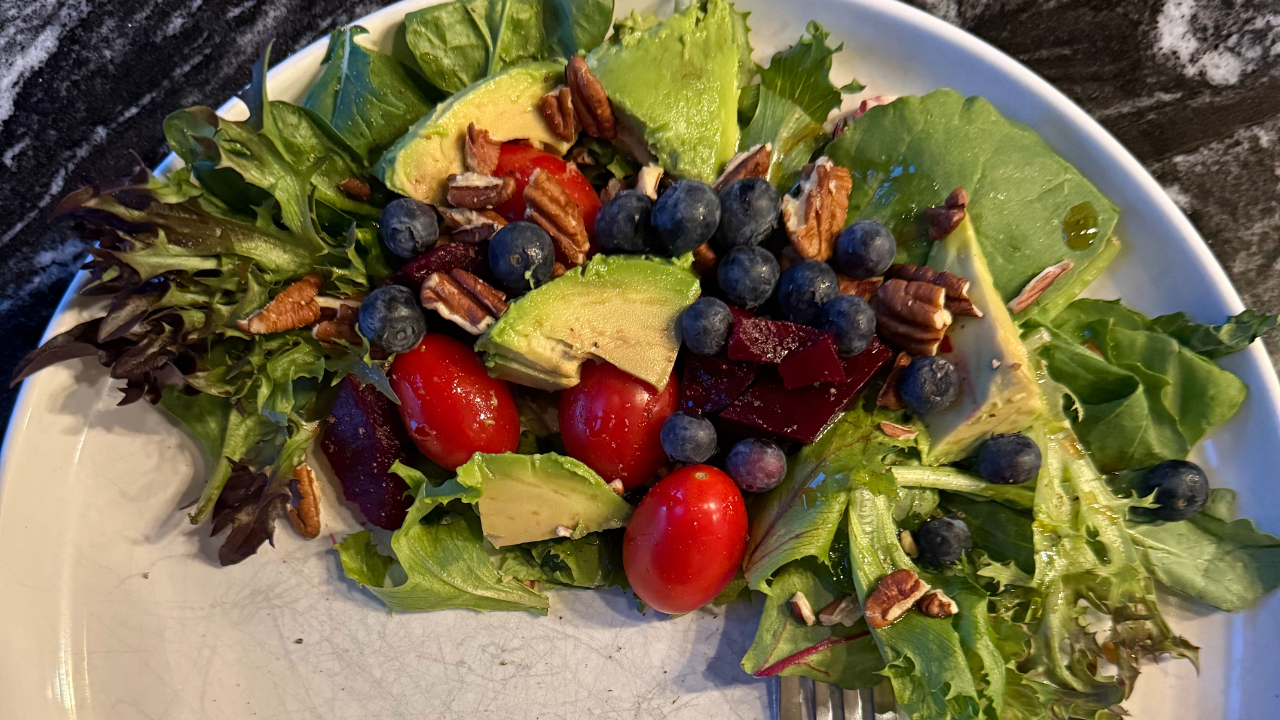
Make the dressing (once, keeps for weeks): Combine 6 oz. real maple syrup, 4 oz. balsamic vinegar, 2 oz. liquid aminos, and 8 cloves minced garlic. Mix and store in a jar.
Build the salad: Pile cups of spinach and arugula onto a plate. If you've got extra minutes, add pickled beets and sliced avocado. Drizzle with unheated extra-virgin olive oil. Drizzle with the prepared dressing. Finish with fresh-ground pepper and a pinch of salt.
That's it. Three minutes. Eat 1/2 a plate of this salad most every night and let the compounding do its thing.
What's So Important About Strong Arteries?
This question probably deserves a "duh," because your arteries are responsible for carrying every nutrient, every molecule of oxygen, every everything to every cell in your body. You smellin' what I'm cookin'? Still...
You Won't Believe This About Your Arteries - It'll Blow Your Mind
If you laid all of your blood vessels end to end — every artery, vein, and capillary — they would stretch approximately 60,000 miles. That's more than twice around the Earth.4 Your heart pumps blood through this entire network continuously, every minute of every day, from the moment you're born.
And they're not just tubes. Arteries are engineered structures with three distinct layers. The innermost layer, the tunica intima, is a single sheet of endothelial cells — the first line of defense against inflammation and plaque, and the layer where vitamin K's MGP activation matters most. The middle layer, the tunica media, is primarily smooth muscle and elastic fibers that control vessel diameter and blood pressure. The outermost layer, the tunica adventitia, is dense connective tissue and collagen that anchors and protects the vessel. Three layers, working together, like a high-performance composite material.5
Think Kevlar. Your arteries are literally like Kevlar.
Your brain alone has roughly 400 miles of capillaries.6 Your muscles grow new capillaries in response to exercise — a process called angiogenesis. Your vascular system is literally alive and adaptive. And when it's not fed properly, the tunica intima stiffens, plaque builds, MGP goes inactive, and the adaptability that makes this system so remarkable becomes a liability.
This matters enormously for active kids, teens, and adults. Higher vegetable nitrate intake is associated with reduced cardiovascular disease incidence and mortality across nearly every reported CVD subtype.1 And vitamin K from greens — combined with the fat in olive oil and avocado that makes it absorbable — is feeding the molecular machinery that keeps those 60,000 miles of vessels clean, flexible, and strong.
For kids and teens especially, building arterial flexibility and protecting the tunica intima now is like laying reinforced concrete instead of cinder block. The research on K1 intake and cardiac structure in adolescents makes this more than theoretical. This is infrastructure. And this salad is the easiest way to build it.
How this Salad Builds Healthy Arteries
Spinach & Arugula
Dark leafy greens are among the richest dietary sources of inorganic nitrate, which the body converts into nitric oxide — a signaling molecule that relaxes and widens blood vessels. A meta-analysis of 113 studies found that dietary nitrate from greens significantly reduces blood pressure and improves endothelial function, the flexible inner lining of your arteries that controls blood flow.1 More greens = more nitric oxide = more flexible, responsive arteries. And that's before we even get to vitamin K, which deserves its own conversation below. For active people of any age, this combination is a big deal.
Unheated Extra-Virgin Olive Oil
The key word is unheated. High heat degrades the polyphenols — the bioactive compounds — that make EVOO so valuable. Research confirms that EVOO's polyphenols, particularly hydroxytyrosol and oleocanthal, promote endothelial function by increasing nitric oxide bioavailability, lower LDL oxidation, reduce arterial inflammation, and support healthy blood pressure.2 The European Food Safety Authority has even approved a health claim for high-polyphenol olive oil specifically for its protection of blood lipids. Drizzle it cold. Every time. (And note: the fat in the olive oil is also essential for absorbing the fat-soluble vitamin K from your greens — these ingredients are working together.)
Raw Garlic
Raw and minced is the right call — crushing or mincing activates alliinase, the enzyme that produces allicin, garlic's key cardiovascular compound. Heat destroys it. A meta-analysis of 12 clinical trials found that garlic supplementation reduced systolic blood pressure by an average of 8.3 mmHg and diastolic by 5.5 mmHg in hypertensive patients — comparable to first-line blood pressure medications.3 It also reduces arterial stiffness and inhibits platelet aggregation. Eight cloves in a batch of dressing? That's your daily dose, spread across the week.
Pickled Beets
Beets are one of the highest-nitrate foods available, and their deep color signals high levels of betalains — potent antioxidants with anti-inflammatory effects. The same nitrate pathway that makes leafy greens powerful applies here in concentrated form. Studies specifically on beetroot have shown measurable reductions in both blood pressure and arterial stiffness.1 The pickled form adds gut-friendly acidity and keeps beautifully in the fridge for quick assembly.
Avocado
Avocados deliver heart-healthy monounsaturated fats, potassium (more per gram than bananas), and a suite of fat-soluble antioxidants. The fat content isn't incidental — it's essential. Fat-soluble nutrients in your greens and beets, including vitamins K and E, require dietary fat for absorption. Adding avocado to this salad makes every other ingredient work better. The fats also contribute to satiety, making this a dinner starter that actually holds you over.
Balsamic Vinegar & Liquid Aminos
Quality balsamic contains polyphenols from grape must that contribute antioxidant activity. Liquid aminos add savory depth and a small amount of amino acids without the sodium load of soy sauce. Together they form the flavor backbone of a dressing that makes you want to eat this salad every night — which is, honestly, the whole point.
Real Maple Syrup
Real maple (not pancake syrup — there's a difference, and it matters) contains over 67 different polyphenolic compounds, including quebecol, which is unique to maple and has demonstrated anti-inflammatory properties. It balances the balsamic and garlic in the dressing while contributing meaningful antioxidant activity. A little goes a long way, and in this recipe it's doing real work.
Fresh-Ground Black Pepper
Don't skip this one. Black pepper is likely the most unassuming, amazing-nutrition food in your kitchen. It contains piperine, which dramatically increases the bioavailability of other nutrients — including curcumin and several polyphenols. It reduces pain in the body. It contains more antioxidants, that last longer (centuries), than almost any other food on Earth. Grinding it fresh preserves its volatile oils. It's a small thing that delivers amazing nutrition AND makes every other ingredient in this bowl more effective.
Vitamin K and Your Arteries
Let's zoom in on one nutrient in particular, because it deserves more than a passing mention. Spinach and arugula are two of the most concentrated dietary sources of vitamin K1 — and what vitamin K does inside your arteries is genuinely fascinating.
How Vitamin K protects the inner layer of your arteries
Your arteries have three layers, and the innermost one — the tunica intima — is the first line of defense against atherosclerosis. One of the biggest threats to that layer is vascular calcification: a process where calcium progressively deposits into the arterial wall, making it stiff, brittle, and increasingly prone to cardiovascular events. Think of it as your arteries slowly turning to stone from the inside out.
Vitamin K's primary role in the vascular system is activating Matrix Gla Protein (MGP) — the most potent known inhibitor of soft-tissue calcification in the body. MGP is produced by the smooth muscle cells and endothelial cells of the arterial wall itself, specifically to prevent calcium from accumulating where it doesn't belong. But MGP only works in its activated (carboxylated) form — and vitamin K is the required cofactor for that activation.7
Without adequate vitamin K, MGP remains inactive. Inactive MGP cannot bind calcium. Calcium deposits in the intima and media layers of arterial walls. Arteries stiffen. Blood pressure climbs. Cardiovascular risk rises. Research confirms that vitamin K also exerts direct anti-inflammatory effects on the arterial wall by antagonizing the NF-κB signaling pathway — the same pathway that drives the chronic inflammation underlying most arterial disease.7
One important clinical note: vitamin K comes in two forms. K1 (phylloquinone), found abundantly in spinach and arugula, primarily supports blood clotting and provides the substrate the body uses for MGP activation. K2 (menaquinones), found in fermented foods and some animal products, is more biologically active for vascular protection and has a longer half-life in the body. The conversion from K1 to K2 in humans is limited — so while your greens are delivering meaningful K1 daily, adding K2-rich foods like aged cheese, natto, or a quality supplement is worth discussing at your next visit if arterial health is a priority.8
A 2017 study published in The Journal of Nutrition found that teens with the lowest vitamin K intake had measurably larger left ventricles — a structural change linked to higher future cardiovascular risk — while those eating more K-rich greens like spinach had healthier heart measurements.9 The vascular system you build in adolescence shapes the one you live with at 50. Every bowl of greens is an investment in that infrastructure. Start 'em young. Put greens on every plate, every night.
Your Nutrition Bite This Week
Easy Habit: Make a batch of the dressing this week. Keep it in the fridge. Pile spinach and arugula on a plate every night before dinner, add the beets and avocado, drizzle with cold olive oil and dressing, grind the pepper. Eat. Repeat. Your arteries will not send a thank-you note — but they will notice. And if you want to talk about adding K2 to your routine, bring it to your next visit.
The research is clear. The recipe is simple. The only thing left is to do it — consistently, every night, until it's just what you do.
No-Excuse Easier Habit: Pile the greens on your plate. Sprinkle with one clove raw garlic. Drizzle with olive oil, drizzle with balsamic vinegar. Salt & Fresh Ground Pepper.
You've got this.
References
- Bondonno NP, et al. Associations between vegetable nitrate intake and cardiovascular disease risk and mortality: A systematic review. Nutrients. 2024;16(10):1511. doi:10.3390/nu16101511.
- Gorzynik-Debicka M, et al. Exploring the benefits of extra virgin olive oil on cardiovascular health: A systematic review. PMC. 2025. PMC12158199.
- Ried K, et al. Garlic lowers blood pressure in hypertensive subjects, improves arterial stiffness and gut microbiota: A review and meta-analysis. Exp Ther Med. 2020;19(2):1472–1478. PMC6966103.
- Texas Vascular Institute. How long are your blood vessels? Citing Poole et al., Journal of Physiology. texasvascular.com, 2025.
- Milutinović A, et al. Pathogenesis of atherosclerosis in the tunica intima, media, and adventitia of coronary arteries. Bosn J Basic Med Sci. 2020. doi:10.17305/bjbms.2019.4320.
- Cipolla MJ. The cerebral circulation. NCBI Bookshelf. 2009. NBK53086.
- Li Y, et al. The inhibitory roles of vitamin K in progression of vascular calcification. Front Cardiovasc Med. 2020. PMC7071387. (MGP as major inhibitor of soft tissue calcification; anti-inflammatory effects via NF-κB antagonism.)
- Halder M, et al. Vitamin K: double bonds beyond coagulation insights into differences between vitamin K1 and K2 in health and disease. Int J Mol Sci. 2019. PMC6413124. (K1-to-K2 conversion limited; K2 more biologically active for vascular protection.)
- Scripps Health / Journal of Nutrition, 2017. Vitamin K intake from leafy greens linked to healthier cardiac structure in teens; lower intake associated with enlarged left ventricle. scripps.org, 2026.
To your health (and your dressing jar in the fridge),
Kelli Jennings, RD
|
|
|
|